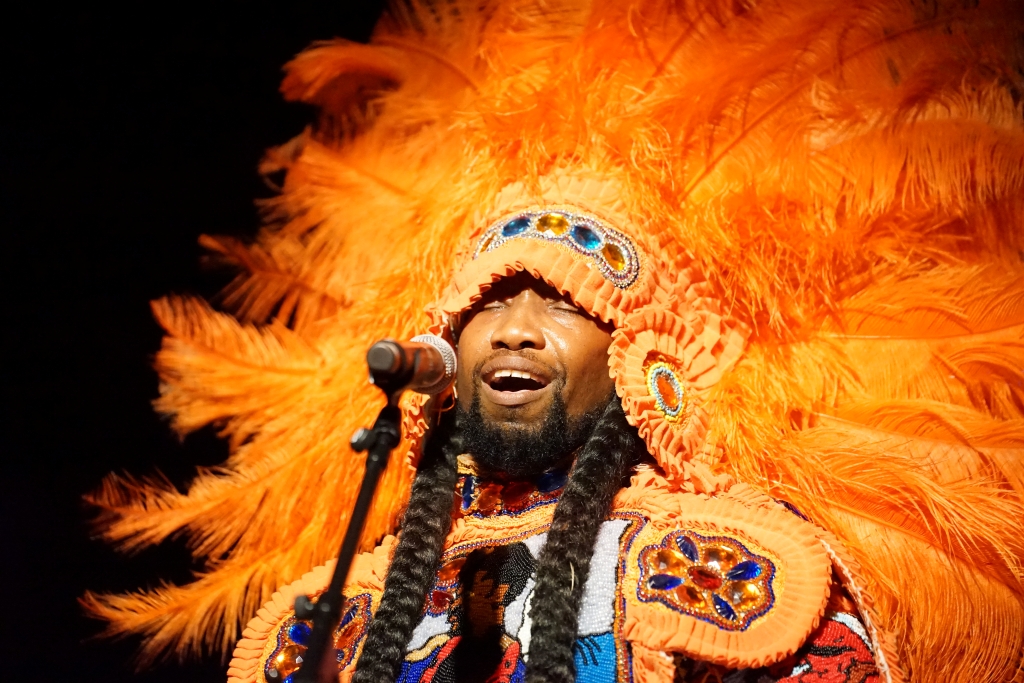
Big Chief Juan Pardo, La communauté est la base de l’ordre tribal
28.09.2026
Opening photo : Big Chief Juan Pardo, Les Rendez-Vous de l’Erdre, Nantes, 28 août 2026 © Sarah Cross
Born in December 1976 in New Orleans, Louisiana, Juan Pardo was bound to become the Big Chief of the Golden Comanche Mardi Gras Indian Tribe as he was immersed in the culture and the community right from his birth.
How did you come to music in general and New Orleans music in particular?
Being born in New Orleans obviously puts me in the place where the music is happening. But as far as music is concerned, like many in the soul and cultural music scene of New Orleans, it started with being in church with my mother. And I often would sing in the junior choir in church.
What kind of church?
Baptist. One of the interesting things that happens in New Orleans is that you may go to Baptist church on a Sunday, but go to Catholic school during the week, Monday through Friday, which is the story of myself.
I attended Catholic school on Monday through Friday, but on Sundays we worshiped at a Baptist church. And my other introduction to music is that I was in a home filled with music all the time with my mother as a gospel singer, but also my father was in the entertainment industry.
He was in the Navy with communications in Vietnam. And when he returned home, he took a career in the radio broadcasting and television industry. So, he taught radio broadcasting at one of the universities in New Orleans for a while. And then he transitioned into the television industry where he was a show producer and operated cameras, all the work that was a lot more complicated back in the days. He did all those things. And I used to go to work with him and I would play on the equipment. I would go into the recording rooms and play around with the things in there. And he was a DJ before I was born, his radio name was Daddy-O.
All kinds of music or some kinds in particular?
All kinds of music. Typically, I was being raised on the Motown sound, the soulful sounds of R&B, of the greats, the Stevie Wonders and the Marvin Gayes of the world. But there was definitely exposure to classical music and country music in my home. My parents come from a time when all that music was available. So, I was exposed to various types of music at all times.
You said that you sang in church, but you were also maybe singing over the records you could hear at home.
Yes. And that was my introduction to music.
One of the things that, as an adult, I found out about myself with music from my early years is I have an unexplainable, well now explainable, connection to the Marvin Gaye song, I Want You. Growing up, whenever I would hear that song, I felt a connection with it that I didn’t understand. And later on, in the years when the internet came around, I was Googling the song, and I noticed that it was the number one song in the year that I was born. So, my connection with that song started before I was born into the world. That song was played on the radio and listened to in my home continuously by my mom. So I understood where my connection to that song came from. It also gave me an understanding of the effect of music of a child in the womb. It was exciting for me to learn that about myself, knowing that I just had a unexplainable feeling when I would hear that song. And it just does something, you know, it settles me, it calms me.
What was your journey to the Mardi Gras Indians, to the Black Indians world and music? How did you become an indian?
Being in New Orleans, I was born into that. The culture was always there, always around from birth.
Either you start out from the parents where they automatically put this upon you, or you’re given the opportunity to grow into it and then choose it. I was given the opportunity to be around it, support it and grow into it and then choose it. Seeing it all my life, I reached the point where I wasn’t participating as a very, very young child, but I was there around it.
Then came a point where from going to parades and just going and doing all the other things that New Orleans had to offer, the spirit of masking began to call out to me. When I hit a point where I could no longer deny it, it was in my later teens. Then I began sewing and working with my brother on his suits, who was a spy boy at the time before he became big chief.
That gradually grew into me knowing that the calling was there for me to begin masking and putting on a suit myself in my early teens.
You don’t have to apply to a specific tribe or something, you can do it on your own?
Well, the tribal pathway from family was already there. There wasn’t really much to think about in that sense as far as family lineage and bloodline goes. That was kind of pre-decided already. There is a pathway to that if it’s necessary. For myself, it wasn’t.
You can start by being a spy, then maybe a flag, or wild, and then big chief.
It is important to understand that this cultural practice often confuses people. They don’t see it as a true tribal practice. What I mean by that is when you think of an Aboriginal tribe, an African tribe, or as we all have been programmed to understand, a Native American tribe, you don’t change the origin story, right?
Because of the secrecy and the necessity to hide this culture, people often think that it is more like a club or a social aid and pleasure thing or something related to Carnival. But it is deeper than that, and it has the same origins as any other tribal existence that we know in the world. When you begin to look at it through that lens, you can truly grasp the understanding, because if the general public sees it only as it relates to the suits and the flamboyantness of it on Carnival or the day that we come out, then you’ll lose it.
You begin as a chief scout, which is an apprentice stage, just like in any tribal order. And then as you grow and you learn the tradition, a chief then sees what your spirit brings to the table, and he then appoints you to a position that he sees best suits you. Like some guys have the mindset, the mental sharpness, and the emotional fortitude to be spy boys, because the spy boy role is important, because he is the first person in the tribe.
And when two tribes meet and they get ready to engage in battle, if you don’t have a level head, smart, sharp individual that has self-control, those meetings between those tribes can become violent. They can become many different things that you may not want to have happen. You must have the right person in the spy boy position because he has to be intelligent, to have emotional intelligence as well and control.
A flag boy is chosen because he is either tall or he has the characteristics of a very precise person in appearances, and he pays attention to detail. The wild man is often chosen because he is the fiercest next to the chief.
Chief more or less being the fiercest, but the wild man is the enforcer of the rules. Playfully, I’ll say that he’s the craziest usually of the tribe. He’s the person that, as we say in the culture, that will run through walls and walk through fire and not be affected. The wild man is considered also the police authority.
You’re tested on your physical stamina, on your mental stamina to be able to place you in the tribal order properly. You learn the history of the tradition. You learn the songs. And then of course, you learn the dance and you learn the visual as well as secret gestures which we use like a sign language. We call it signals. There is a process in which I can move my body in certain ways, which communicates certain things. Other tribes will understand it. And there are things no one outside of your tribe will understand. We have universal languages and signals that we all understand as a tribal nation. However, each tribe may have individual dialect and signals that only them interpret a certain way. That is just the multifaceted layers that we have within the culture itself.
We have universal languages and signals that we all understand as a tribal nation, however, each tribe may have individual dialect and signals that only them interpret a certain way.
Big Chief Juan Pardo
Can you tell us about the history of Black Indians? How did it happen, this mixture between Black and Native American cultures?
Whether it is Eastern education or Western education, we all have for many years come under the same historical references to Native Americans.
But through scientific proof, and through the journals of Cortez and other explorers, explorers before Columbus, we know now that in the US territories and other areas, there were people of dark complexion, melanated people in the Americas prior to the transatlantic slave trade. We must erase the programming that has been put in place to truly understand the Black masking Indian story. There is a popularized version of our history, where it is said that when the slaves would arrive on the ships, the ones that would escape their slave masters, they would run into the swamps and bayous of Louisiana and then be welcomed into the Native tribes.
In that story, you read that the enslaved would hide and blend in among the tribes. Let’s think about this for a second. If a person from Congo, from the diaspora, arrived in the United States and ran into a village or into a tribal order, and then could blend in and hide, would that be the exact Native Americans that we know in our history books?
That is the first thread that we want to use to begin to follow this story. Those people who they were meeting and hiding among looked like them. And I will give you another way to prove that this must happen, not as something like we as a culture are making up, but these are threads of proof.
The fleur-de-lys, which is very prominent here in France, and is also the logo of New Orleans’football team, right? That fleur-de-lys was used as a brand. It was heated up by fire, pressed upon the skin of slaves.
This began happening because when they would escape, they couldn’t tell them apart. When they would arrive at these tribes and try to take back their slaves, they were not be able to know who was who. So, they began branding to be able to claim them as property. That is the next layer of proof, the thread, that people that resemble me were already there in the Americas.
But these people all lived together and co-mingled. The original name of New Orleans was Bulbancha, a native word that has been recorded by settlers coming from Europe.
That word means the land of many tongues. New Orleans is known as a place of multiple trades for people coming from all over the Caribbean and all over the United States, speaking various languages, learning each other’s languages. To have a name like, it proves this was happening there before the arrival of other people. That is the true history you must understand that the tribal order existed already.
What we express today is the melting pot of what Bulbancha meant. It was the mixing of all these different tribal traditions coming together, giving birth to what you see today that we call Black Masking Indian, or historically known as Mardi Gras Indian.
It began to morph because when the native tribes begin to accept people from the Africa, from the Caribbean, they brought with them their beating styles, their dance styles, their rhythms, and they exchanged these things as they became members. We pay homage to that union, to the natives as we know them in our history books, as well as the ones that we are now learning to acknowledge.
In our culture, we’re paying homage to that union of those indigenous accepting those from the diaspora and from everywhere that came together and would marry into these tribes. And that began the bloodline of many of the citizens of New Orleans today. That is why that bloodline and that spirit still exist. That’s why really it has never been broken, even though the culture itself from the time of colonization became outlawed. So, there was a period of oppression of expression.
That is what drove what we know today as our culture to be into an underground hidden culture. And this culture remained hidden for many years until the modernization, and someone saw it and begin to document it and then begin to tell others about it. And from that original documentation, you get the first publicly known name of our cultural heritage and our tradition, which is Mardi Gras Indian.
The reason you saw the Mardi Gras Indian on Mardi Gras is because that was the only day it would be safe for you to practice this tradition because it was illegal to wear feathers. It was illegal to drum. It was illegal at a point for women to wear wraps around their heads. It was illegal to be yourself, to have this cultural expression. On the day everyone was wearing crazy costumes and drinking and going into the French Quarter, when everyone, slave owners and police and all these other people were in the French Quarter celebrating, that left the indigenous and the slaves to themselves. That was the day with no one around to harm you, to arrest you, beat you.
You begin to drum, to sing, to wear your traditional garment, your traditional ceremony attires because you can now freely do it without persecution. This is where the celebration of Mardi Gras coincides with true traditional cultural practice. That’s where the line gets blurred and people associate the traditional practice with Mardi Gras revelry.
Not only do we mask, but carnival itself provided the mask. It provided cover, the mask itself for us to be ourselves. That is the most important part of the story to get everyone start to know who we are. Researching this culture is to really get to the truth and start there. And then the layers begin to unfold because a lot of it’s public.
And that moment where all these people were free to behave as they wanted, was it on Congo Square?
During the French rule, the Code Noir, the French believed that the enslaved and people of color in New Orleans were Christian. Because of that, they didn’t work on Sunday.
They basically gave them Sunday off when New Orleans was under French rule. And with that, they had the space of Congo Square that became known as Congo Square where they would then do the drumming and the practicing and do all of these things because they were left free to their own devices.
Congo Square was not just a place of drumming and dance. It was also a place of trade and barter systems. There was a lot of things happening. It was kind of its own central city with a performance space. It functioned and operated at its highest point on Sundays. That’s where the biggest cultural exchange came with everyone from everywhere, because the enslaved were being taken from all parts of Africa and throughout the Caribbean.
They all shared what they had at that moment, there were different foods that were exchanged and sold and bought there, as well as different dances and different rhythms. That gave birth to, of course, jazz and the rhythms that we know around the world that originate in New Orleans. That began that rhythm that we know to be New Orleans, that rhythm with everyone speaking at the same time, but it all rhythmically was making sense.
And that was uniquely done there in New Orleans before anywhere else. There’s also a way of what we call playing the dozens. And all that was incorporated with rhythm, which gave birth to the first versions of what we know today to be rap and hip hop. All that derives from that moment.
Let’s talk about Katrina. How did the tribal system overcome that period?
There was an impact. There were changes to the city, changes to the people, even changes to the culture. You couldn’t be ready for them because you didn’t see it coming. One of the things with Katrina, it spread out a lot of elders. We lost a lot of elders due to the stress of Katrina. The effects of Katrina also disturbed the concentration of tribal existence in the community.
Before Katrina, many tribal members were all in the same area. We lived as a village. We lived as tribally as a village, in modern homes, but it was the same philosophy of being in a community.
If you dig into the black masking history, you understand that the community is in large part of what is the fabric of the tribal system. Because we existed the same way tribes did. Now, because of Katrina, tribes are not necessarily all in the same community, just because it wasn’t possible once everything was destroyed.
As time grew, we had to find a way to get back into some sense of wholeness. It is a coming little bit now because as younger generations come in, they’re starting to be in clusters again. There is something moving inside of this, inside of culture from a spiritual realm that is taking care of culture. It’s taking care of us. It’s actually taking place without us even doing it on purpose.
We’re not specifically trying to put each tribal member back in the same area, but as the youth gravitate toward becoming members and getting there, starting that thing, that kinship, because a friend and a cousin who are now back in the same areas and it’s beginning to happen again, naturally, organically. I believe that’s just spirit, the tribal spirit doing what it needs to do to put things back in order.
As a chief, do you have to, to take care about this, to manage it?
As a chief, you have the same responsibilities today as you had in 1603 or 1876.
The tribal order does not change. The tribe depends on the chief for council, the decisions about things that are going to happen culturally and environmentally. A great way to explain that is, within my tribe we have a gardening system where we all garden and grow certain products. When you have a large garden, you’re going to grow an abundance beyond what you need. So, we then bring that to the table for other tribe members to get the abundance outside of what you need. The same thing is happening with their gardening. That is a very ancient way of doing things and it is present in my tribe now. Those are some of the things that are on the surface, every people don’t realize it’s happening from a tribal standpoint. Also, with the children, when the parents need to go out or need to attend an event, the big queen can easily become the babysitter of whomever in the tribe needs a babysitter at the time.
If we removed the modern things, and we just had huts or teepees, that same thing would have happened. As the men went out to as hunter gatherers, they would leave the kids there. Same thing is happening now just in modern times, instead of showing up on a horse, we drive up in a car. When you strip away the mindset, and you simplify it, and you turn these horses into cars and these teepees into homes, you realize the tribal order is still in place, and we’re living the same way today.
As a chief, you have the same responsibilities that you’ve had over the years. Your council, your extended uncle, your extended family, your council, advisor, all of these things.
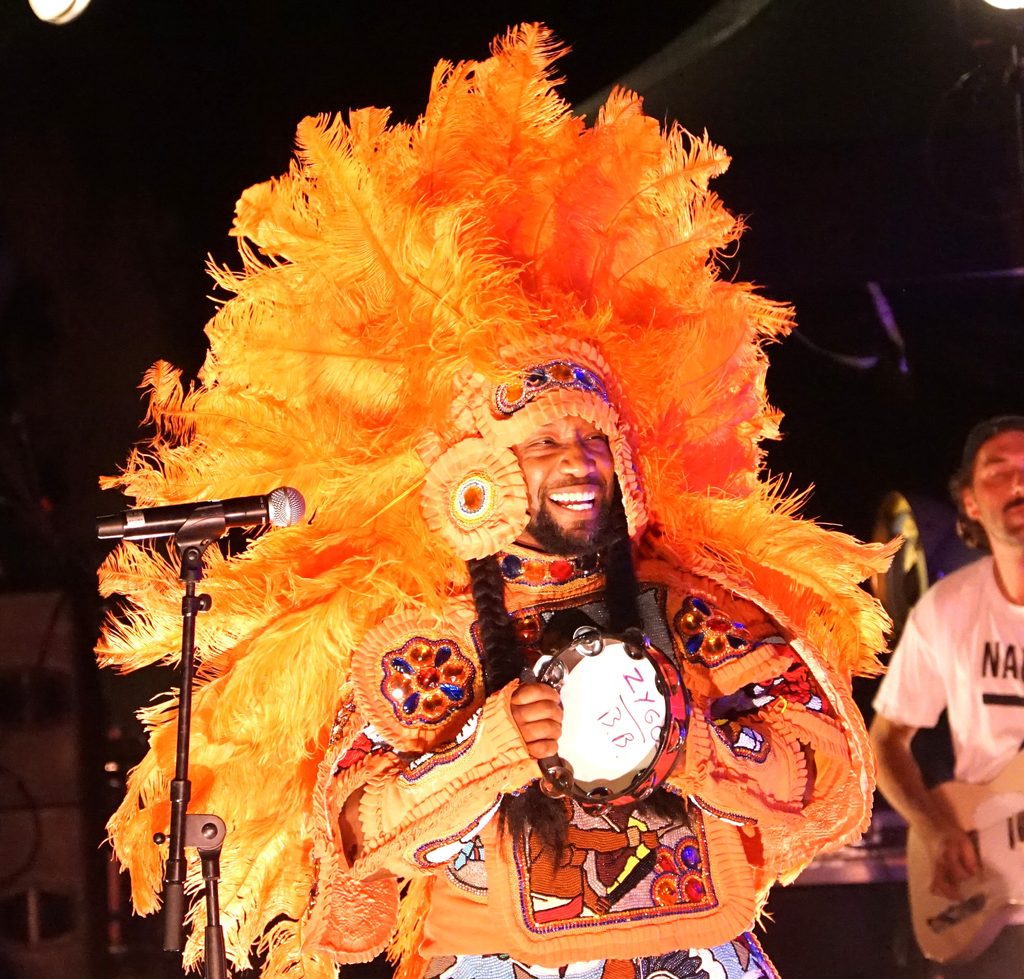
Do you make your own suits? Do you have to make a new one every year?
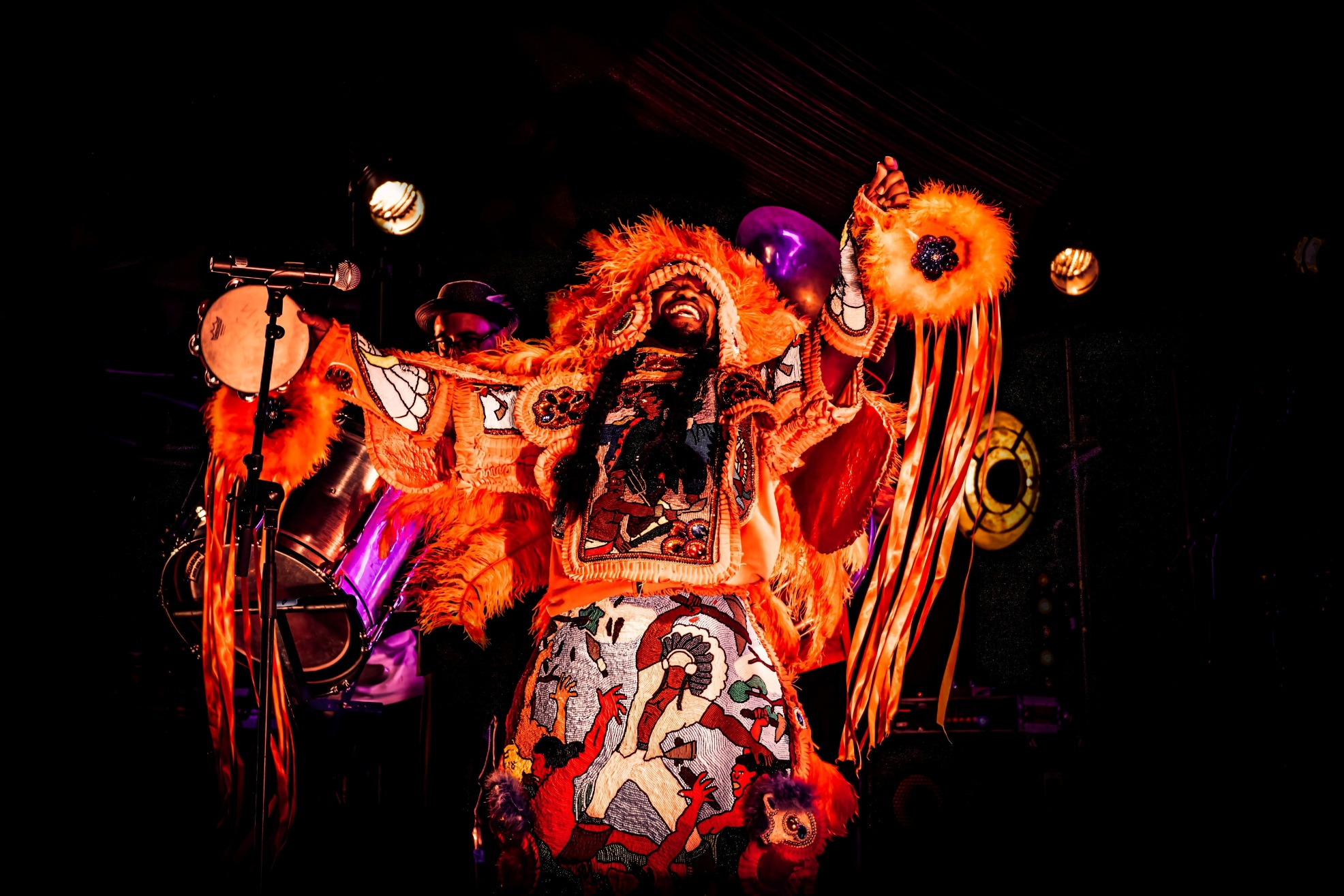
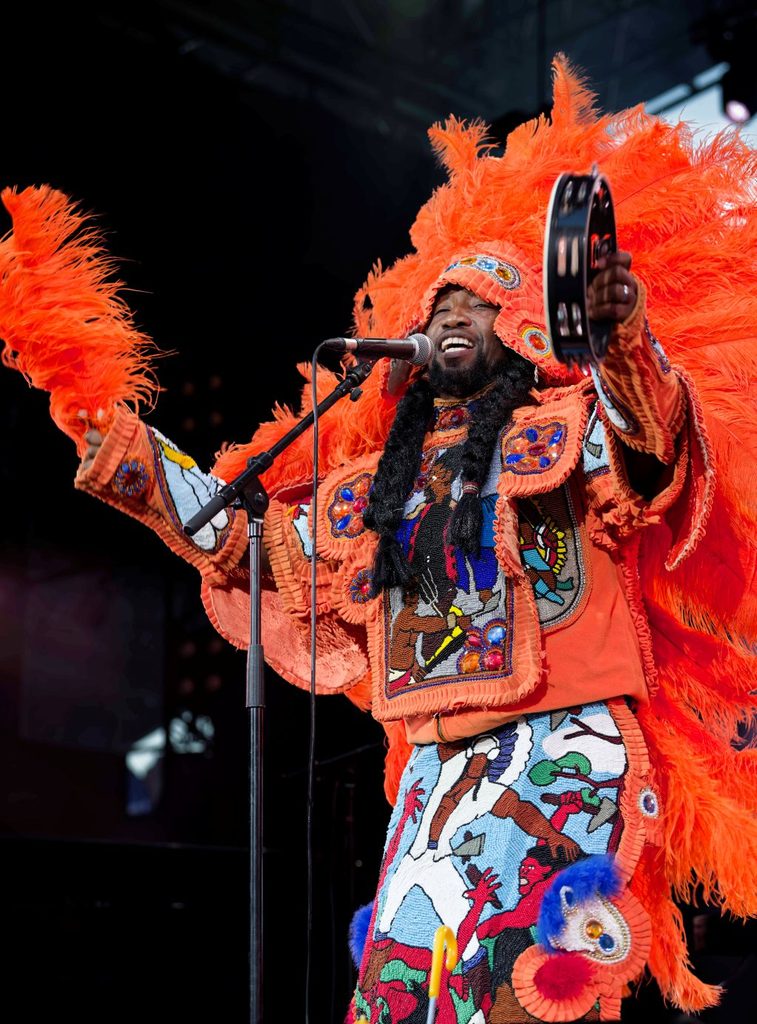
Every year that you intend to participate on Mardi Gras day, you have to create a new suit, and it must be created by the individual.
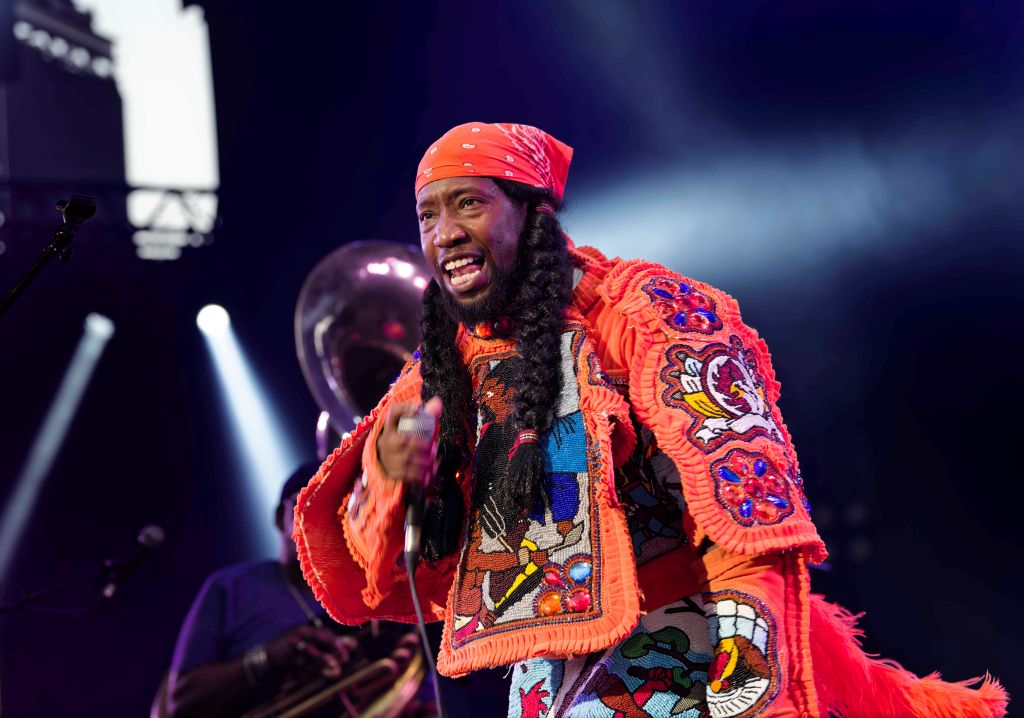
The suit tells a story. The stories come from dreams, from things you learn through life. It is an expression that you want to give to the world in the story that you want to tell, and that is decided upon by the individual.
So, some guys, some of the queens, they may have a dream about something that speaks to their spirit, and so they would begin to put a suit together that expresses and tells that story. For instance, I have a suit that was dedicated to one of my uncles, and it was telling a native story as well as telling a modern story of my own, which is about the story where they say, give a man a fish, you feed him for a day, teach him how to fish, and he’ll eat forever. So my uncle Peter is kind of the lead hunter-gatherer of our family, and he was the first person to take me fishing when I was six or seven years old.
We used to go to an area in Louisiana called Grand Isle, which is like an island right off the coast, just before you enter into the Gulf of Mexico. In the suit, I beaded the redfish, which we call Louisiana redfish, it’s called a black bass here in France. That fish is known to be a fierce fighter. Catching one of those at seven years old is almost like catching a whale. That was the first time I caught a redfish. That’s the story that I told through the scenes and the pictures on my suit.
Each year, it is something different. Most recently, the suit that I had on this past Mardi Gras was telling the story of the cobalt mines in Congo. The spirit animal that I put on the suit was the gorilla because I, as I’ve been heavily into fitness lately, I identified with the strength and fortitude of the gorilla.
At the same time, there is also the play on words where the gorillas of the Congo were a military group as well. So in the wing portions of my suit, I have the gorillas with the guns, which is the actual military gorillas. Then in the in the chest, the collar, and in the headdress, I have the gorilla itself, the animal.
In the pictures inside, I show children working in cobalt mines. And at the very top, there is a picture of a mother holding her deceased child that was working in the cobalt mines, the same child who you can see working in the cobalt mines in the pictures at the bottom of my apron. I created that suit to generate awareness to the fact that children are dying for us to have multiple cell phones that we dispose of and get another one.
In our modern society, there are other ways to get cobalt out of these mines. We are flying rocket ships to the moon, certainly we can get cobalt out of the ground without using infants and children to do it. That was an important thing to me because of all of the atrocities that happened to be going on in Congo at the time, being led by tech industry. I just felt like a lot of times in the US, that message isn’t there, we’re only getting our devices and going on about our day and we are not concerned with the atrocities that are happening around the world to get that cell phone and that laptop to us.
I just wanted to bring awareness to that, in hopes of sparking a conversation with the right people. Hopefully, there may be some adults that know how to run this equipment and extract this cobalt in a more humane way to allow these children to grow up and become adults instead of dying in landslides and in cobalt mines. That’s the kind of the storytelling that goes on in this suit.
Interview conducted by Christophe Mourot in August, the 28th
Live Report Big Chief Juan Pardo at Rendez-Vous de l’Erdre 2026
Live Report Big Chief Juan Pardo at Técou en Blues 2025